Leh Ladakh Tour Packages — Real Itineraries, Real Permit Rules, Honest Costs
Last updated 2 Sept 2026 · Written and reviewed by YashTrip planners
Why Ladakh, and who it actually suits
Ladakh is the one Indian destination where the landscape does the heavy lifting. You do not have to be sold on it. What you do have to get right is the sequencing — because Ladakh is the only mainstream Indian holiday where a badly ordered itinerary can genuinely make someone ill.
Leh's airport, Kushok Bakula Rimpochee (IXL), sits at 3,256 m / 10,682 ft — the highest commercial airport in India (Wikipedia). You step off a 90-minute flight from Delhi into air with roughly a third less oxygen than you left. That single fact drives everything else on this page.
Ladakh suits: couples who want scale rather than luxury, families with teenagers, photographers, motorcyclists, and anyone who has done Manali and Shimla and wants a genuine step up. It suits less well: families with children under about six, anyone with uncontrolled hypertension or a recent cardiac event, and travellers who only have four days. Four days in Ladakh is two days of acclimatising and two days of driving.
Permits: the single most misunderstood thing about Ladakh
This is where most competitor pages are simply wrong, so read it carefully.
Indian citizens do not need an Inner Line Permit for Ladakh. The official LAHDC Leh permit portal states it plainly: "The inner line permit is applicable only to foreign tourists." (lahdclehpermit.in/faq). The ILP requirement for domestic travellers was replaced in 2021 by an Environment Fee (EDF) system.
What Indians actually pay, online, before travel:
| Charge | Amount | Basis |
|---|---|---|
| Environment / green fee | ₹400 per person | One-time |
| Wildlife fee | ₹20 per person | Per day |
| Red Cross Fund | ₹50 per person | One-time, optional — you can skip it |
A seven-day trip therefore works out to roughly ₹590 per person including the optional Red Cross contribution (₹400 + ₹140 + ₹50) (discoverwithdheeraj.com).
That one receipt covers Nubra Valley, Khardung La, Pangong Tso, Tso Moriri, Turtuk, Hanle, Chusul, Man, Merak, Nyoma and Dah-Hanu. There is no separate per-lake permit. Book it at lahdclehpermit.in — and note two traps: the portal locks a photo-ID number for 15 days, so the same Aadhaar cannot be reused to re-issue a permit inside that window, and there is a 10% discount when the permit is raised through a registered local agent.
Foreign nationals are a different case entirely — they need a Protected Area Permit. Citizens of Pakistan, Afghanistan and China need MHA clearance; diplomatic, UN and journalist passport holders need MEA clearance (lahdclehpermit.in/faq).
Altitude: what we insist on, and why
We build every Ladakh itinerary around a 48-hour acclimatisation window in Leh before any high pass. This is not caution for its own sake — it is the health advisory published on the official Leh permit portal, and since 2022 a minimum two-day acclimatisation has applied before crossing Khardung La (Wikipedia: Khardung La).
The passes you will actually cross:
| Point | Altitude |
|---|---|
| Leh airport (IXL) | 3,256 m / 10,682 ft |
| Khardung La | 5,359 m / 17,582 ft |
| Chang La | 5,360 m / 17,590 ft |
| Pangong Tso | 14,270 ft (Leh district administration figure) |
A note on honesty: the summit board at Khardung La claims 5,602 m / 18,379 ft. GPS and satellite survey data put it at 5,359 m (Wikipedia). Take the photo, enjoy the sign, but the real number is the smaller one. Similarly, Pangong's altitude is given as 14,270 ft by the Leh district site and 4,225 m (13,862 ft) by Wikipedia — we quote the district figure and flag the discrepancy rather than pretending it doesn't exist.
Practical rules we give every group: no alcohol on days 1 and 2, no shower on arrival day if you're feeling heavy-headed, three to four litres of water daily, and a Diamox conversation with your own doctor before you fly — not with a hotel manager after you land.
When to go — month by month
| Month | Verdict | Why |
|---|---|---|
| Jan | Avoid | Air access only. Khardung La mean daily max around −19 °C. Chadar trek territory, not holiday territory. |
| Feb | Avoid | Same. Specialist winter trips only. |
| Mar | Avoid | Srinagar–Leh highway has opened as early as mid-March in some years, but it is a gamble. |
| Apr | Marginal | Srinagar–Leh typically opens late March to mid-April; Manali route still shut. Lakes may still be frozen. |
| May | Good | Manali–Leh usually connects mid-May. In 2026 BRO connected it mid-May with two-way tourist traffic from 1 June. |
| Jun | Best | Everything open, snow walls still standing on the passes, before the July rush. Expect water crossings and slush near Baralacha La. |
| Jul | Good | Warmest month, biggest crowds, highest hotel rates. |
| Aug | Good | Ladakh is a rain-shadow desert and stays dry — but the approach roads through Himachal and Kashmir carry landslide risk. |
| Sep | Best | Clearest light of the year, thin crowds, stable roads. Our pick for photographers. |
| Oct | Good to mid-month | After roughly 15 October, early snow can shut Tanglang La or Lachulung La without warning. |
| Nov | Avoid | Land routes closed. |
| Dec | Avoid | Air only. |
Sources for the 2026 road picture: discoverwithdheeraj.com — Manali-Leh 2026 and Srinagar-Leh status. Before you finalise dates, the official position is published at leh.nic.in/weather-and-road-status.
How many days you actually need
- 5 days — Leh, Nubra, Pangong. Tight but it works if you fly in and out. You will be acclimatising and driving, with little time to sit still.
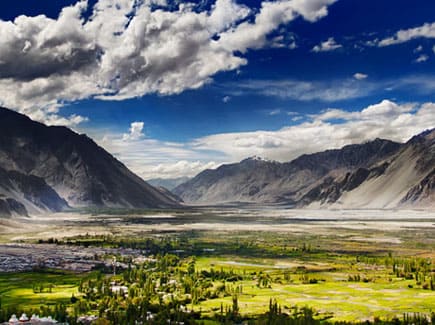
- 6–7 days — the sweet spot. Adds Turtuk (the last village before the Pakistan border, and the best food in Ladakh), or Tso Moriri.
- 9–11 days — Ladakh with Srinagar, or Ladakh overland from Manali. Only worth it if you actively want the drive.
Three sample itineraries
A. Ladakh Essentials — 6 days / 5 nights, fly in fly out
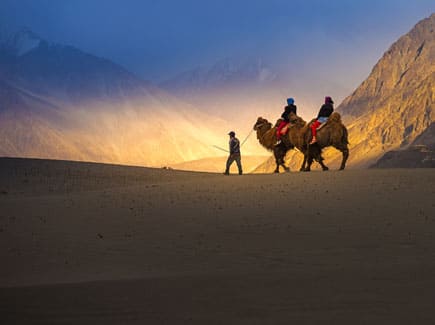
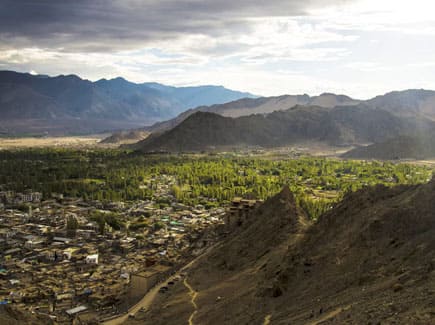
Day 1 — Delhi–Leh flight (all Leh flights operate in the morning because of afternoon mountain winds; the approach is one-directional). Transfer to hotel. Nothing else. Rest, hydrate, short walk to Leh Main Bazaar in the evening if you feel fine. Overnight Leh. Day 2 — Acclimatisation day. Shanti Stupa, Leh Palace, Hall of Fame museum. Nothing above 3,600 m. Overnight Leh. Day 3 — Leh to Nubra via Khardung La (about 5 hours' driving with photo stops). Diskit Monastery and the Maitreya Buddha statue, sand dunes and double-humped camels at Hunder. Overnight Hunder or Diskit. Day 4 — Nubra to Pangong Tso via the Shyok route (roughly 6–7 hours, rough in patches). Sunset at the lake. Overnight in camps or a homestay at Spangmik or Merak. Day 5 — Pangong back to Leh via Chang La (about 5–6 hours), stopping at Thiksey and Shey. Overnight Leh. Day 6 — Morning flight to Delhi.
B. Ladakh Wide — 8 days / 7 nights
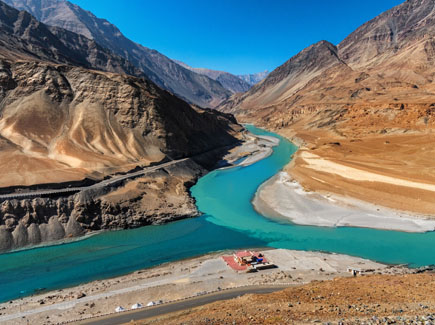
Days 1–2 as above. Day 3 Sham Valley loop — Magnetic Hill, Gurudwara Pathar Sahib, Sangam (Indus–Zanskar confluence), Alchi and Likir monasteries, back to Leh. Day 4 Leh–Nubra via Khardung La. Day 5 Nubra to Turtuk and back (about 3 hours each way) — Balti village, apricot orchards, a border history most Indians have never heard. Day 6 Nubra–Pangong via Shyok. Day 7 Pangong–Leh via Chang La. Day 8 fly out.
C. Srinagar–Kargil–Leh overland — 10 days / 9 nights
Days 1–3 Srinagar and Sonmarg — now reachable year-round since the 6.5 km Z-Morh / Sonamarg Tunnel opened on 13 January 2025 (discoverwithdheeraj.com). Day 4 Srinagar–Kargil over Zoji La (11,578 ft), stopping at Drass. Day 5 Kargil–Leh via Lamayuru and the Moonland. Day 6 rest and Sham Valley. Days 7–9 Nubra, Pangong, back to Leh. Day 10 fly out. This route acclimatises you gradually by road, which is physiologically kinder than flying straight into Leh — the trade-off is four extra days.
What it honestly costs
*₹19,000–₹38,000\ per person (indicative · 6N/7D · land-only ex-Leh · twin sharing · excludes GST & TCS)**
*\Indicative market range as of Aug 2026. Contact us on +91 97299 91755 for a current quote.
With Delhi return flights included, the comparable market band is:
*₹45,000–₹55,000\ per person (indicative · 6N/7D · ex-Delhi with flights · twin sharing · excludes GST & TCS)*
*\Indicative market range as of Aug 2026. Contact us on +91 97299 91755 for a current quote.
Where those numbers come from: live listings on 13 Aug 2026 showed 5D/4N Leh with Pangong at ₹19,000, 7D/6N with Turtuk at ₹19,900, 6D/5N at ₹22,900, 10D/9N "Wonders of Ladakh" at ₹36,800, and a 7D/6N ex-Delhi package with flights at ₹49,990 (thrillophilia.com/cities/ladakh/tours). A second operator listed 4D/3N at ₹16,499 and 6D/5N Leh–Nubra–Pangong at ₹23,999 (travelcoffee.in).
What pushes the price up: July departures, hotel category in Leh (the gap between a clean 3-star and a boutique property is large), a Pangong camp with an attached washroom versus a shared block, a dedicated Innova versus a shared Xylo, and any add-on to Hanle or Tso Moriri, which are long driving days that consume a vehicle for two full days.
What usually is included: accommodation on twin sharing, breakfast and dinner (Ladakh runs on MAP, not CP), all transfers and sightseeing by a permit-cleared vehicle, driver allowances, and the Environment Fee.
What is usually excluded and catches people out: flights, lunch, monastery entry tickets, the oxygen cylinder in the vehicle if you want one dedicated to your group, camel rides at Hunder, ATV rides at Pangong, and — critically — the cost of an extra night if a pass closes. Ask any operator, including us, exactly who pays for a weather-forced extra night. Get it in writing.
Getting there from Delhi NCR
- By air — direct Delhi–Leh flights operate on Air India, IndiGo and SpiceJet (Wikipedia: IXL). All morning departures.
- By road via Manali — 431 km via the Atal Tunnel, 12–14 hours of driving, which we always split across two days with a halt at Jispa or Sarchu. The four passes are Baralacha La (16,047 ft), Nakee La (15,547 ft), Lachulung La (16,616 ft) and Tanglang La (17,582 ft). In 2026 BRO connected the highway mid-May and full two-way tourist traffic began 1 June (discoverwithdheeraj.com).
- By road via Srinagar — opens earlier, typically late March to mid-April. Early in the season Zoji La runs one-way alternating traffic: even dates Srinagar→Kargil, odd dates Kargil→Srinagar.
- By rail — there is no railhead in Ladakh. The nearest is Jammu Tawi (leh.nic.in).
The 13.15 km Zojila Tunnel achieved its final excavation breakthrough on 9 June 2026, but the target for full operation is February 2028 — it changes nothing for the 2026 or 2027 seasons.
What to pack
Layers, not bulk. A fleece plus a windproof shell beats one heavy jacket, because you will move between 12 °C sun and 2 °C wind in the same hour. Add: sunglasses with real UV protection (glare off snow at 5,000 m is brutal), SPF 50, lip balm, a woollen cap for Pangong nights, one pair of broken-in shoes, a power bank, and cash. ATMs in Nubra and around Pangong are unreliable at best.
Also: prepaid SIMs issued outside J&K and Ladakh often will not work. Carry a postpaid connection or accept that you will be offline for stretches. Download offline maps before you fly.
Food and things worth naming
Skyu and thukpa at a Leh Old Town café. Apricots and apricot jam in Turtuk — genuinely the best produce in the region. Butter tea, once, so you can say you tried it. The German Bakery cluster on Changspa Road for a soft landing on day one. And in Nubra, ask for chhutagi, a Ladakhi pasta stew that almost never appears on a tourist menu.
Common mistakes
- Flying in and driving to Khardung La the same day. Every year someone tries. Every year someone is evacuated.
- Applying for an Inner Line Permit as an Indian citizen. You don't need one. You need the Environment Fee.
- Booking Pangong camps in peak July without checking washroom arrangements. "Luxury camp" means very different things at 14,000 ft.
- Assuming August rain will hit Ladakh. It won't — Ladakh is a cold desert. It will hit the roads into Ladakh.
- Planning a return flight with a tight onward connection. Leh flights cancel for weather. Never book an international connection the same day.
- Not carrying printed documents. There is no network at several checkposts.
Frequently asked questions
Do Indian citizens need a permit for Leh Ladakh in 2026?
No Inner Line Permit is required for Indian nationals — the official LAHDC Leh portal states the ILP applies only to foreign tourists. Indians instead pay an online Environment Fee: ₹400 one-time plus ₹20 per person per day, with an optional ₹50 Red Cross contribution. A seven-day trip costs roughly ₹590 per person. Apply at lahdclehpermit.in before you travel.
What is the best month to visit Ladakh?
June and September. June gives you open roads with snow still standing on the passes and slightly thinner crowds than July. September gives the clearest light of the year, stable road conditions and far fewer people. July is warmest but busiest and priciest. Avoid November through March unless you are specifically going for a winter expedition.
How many days do I need for a Ladakh trip?
Six to seven days is the realistic minimum for Leh, Nubra and Pangong with proper acclimatisation. Five days works only if you fly both ways and accept a compressed pace. Anything under five days means you spend the whole trip either acclimatising or driving. Add two days if you want Turtuk or Tso Moriri.
Is Ladakh safe for children and elderly travellers?
Children over about eight and fit older travellers manage Ladakh well with a proper two-day acclimatisation in Leh. We do not recommend it for children under six, for anyone with uncontrolled high blood pressure, or for anyone with a recent cardiac or respiratory event. Get medical clearance from your own doctor before booking, not after.
When does the Manali–Leh highway open?
Typically mid-May to early June. In 2026, BRO connected the highway in mid-May, ran about two weeks of alternate-day traffic on the Darcha–Sarchu section, and opened full two-way tourist traffic from 1 June. It is not recommended after mid-October, when early snow can close Tanglang La or Lachulung La at short notice.
Do I need to worry about altitude sickness?
Yes, and planning handles it. Leh sits at over 3,200 m and Khardung La at 5,359 m. We build a mandatory 48-hour rest in Leh before any high pass — this is the official health advisory, not our own caution. Avoid alcohol for the first two days, drink three to four litres of water daily, and discuss Diamox with your doctor before you fly.
Can I do Ladakh by bike, and what does it cost?
Yes — Ladakh bike trips are widely run from both Leh and Manali. Market rates on 13 Aug 2026 showed a 6D/5N Leh-based bike trip at ₹29,800 and a 12D/11N Manali–Leh–Srinagar ride at ₹39,800 per person. Riders still need the same Environment Fee, and the same acclimatisation rules apply — arguably more so, because riding is physically harder than sitting in a car.
Are Pangong Tso and Nubra Valley covered in one permit?
Yes. The Environment Fee receipt covers Nubra Valley, Khardung La, Pangong Tso, Tso Moriri, Turtuk, Hanle, Chusul, Man, Merak, Nyoma and Dah-Hanu. There is no separate per-destination permit for Indian travellers. Carry a printed copy — mobile networks fail at several checkposts.
What is the cheapest time to visit Ladakh?
Early May and late September to mid-October, when the roads are open but the peak-season hotel and vehicle rates have not kicked in. July is the most expensive month. The catch with shoulder season is weather risk: an early-May trip can be disrupted by a delayed road opening, and a mid-October trip by early snow.
Should I fly into Leh or drive in from Manali?
Fly if you have under eight days. Drive if you have ten or more and actively want the road — the Manali route acclimatises you gradually, which is easier on the body, but costs two full days each way and puts you at the mercy of four high passes. Many travellers do the sensible hybrid: drive in from Manali or Srinagar, fly out from Leh.
Will my mobile phone work in Ladakh?
Partially. Prepaid SIMs issued outside J&K and Ladakh generally do not work — carry a postpaid connection. Coverage is reasonable in Leh town, patchy in Nubra, and effectively absent around Pangong and on the passes. Download offline maps and tell family at home to expect gaps.
What happens if a pass closes and we lose a day?
This is the question to ask every operator, including us. Weather closures are not rare in May, June and October. Establish before you pay: who bears the cost of the extra hotel night, whether the vehicle is retained at no charge, and what happens to a missed flight. We put ours in writing on the quote. Many operators don't.