Thailand Tour Packages From Delhi — The Visa Rule Everyone Gets Wrong, Real Costs, And Itineraries That Work
Last updated 2 Sept 2026 · Written and reviewed by YashTrip planners
First, the visa — because half the internet has it wrong
If you have googled "Thailand visa for Indians" recently, you have probably read that Thailand "ended visa-free entry for Indians", or that Indians are "back to a 15-day visa on arrival". As of our check on 27 August 2026, both claims are wrong, and we will show you exactly why rather than asking you to take our word for it.
Here is the actual sequence, from official Thai sources:
- Since 2024, Indian ordinary-passport holders have entered Thailand under a 60-day visa exemption — no visa, no fee, a stamp at the counter.
- In mid-2026, the Thai Cabinet reviewed the whole exemption scheme. Its decision of 16 July 2026 — reported by the Tourism Authority of Thailand's official newsroom (tatnews.org) — places India in a 30-day visa-exemption category.
- That change takes legal effect only 15 days after publication in the Royal Gazette. As of 27 August 2026, that publication has not happened. So the 60-day rule is still the one applied at the airport today.
- At no point in the approved framework does India lose visa-free entry or fall back to visa on arrival. The change, when it lands, is 60 days becoming 30 — which affects almost no holiday traveller, because almost nobody holidays in Thailand for more than a month.
What this means for you, practically: you do not need a Thai visa for a holiday, today or after the change. What you do need — and what a surprising number of package pages never mention — is the TDAC.
The TDAC — the form competitors forget to tell you about
Since 1 May 2025, every foreign national entering Thailand must submit a Thailand Digital Arrival Card (TDAC) online before arrival. It replaced the old paper TM6 form. The facts, from the Thai Immigration Bureau's official portal:
- File it at tdac.immigration.go.th — the official site. It is free. Anyone charging you for a "TDAC visa" is selling you a form-filling service, or worse.
- File within 72 hours (3 days) before arrival, not earlier.
- One TDAC per person per entry — children included, and a fresh one every time you re-enter.
- You will need passport details, flight number, and your first hotel's address. Save or screenshot the QR code it issues.
When you travel with us, we file the TDAC for every passenger as part of the package — it is a ten-minute job that ruins a holiday when forgotten at 2 am in the immigration queue.
One more quiet rule worth knowing: Thai immigration is entitled to ask arriving tourists for proof of funds — commonly cited as 10,000 baht per person or 20,000 per family — and occasionally spot-checks. It is rarely enforced on package tourists with return tickets and hotel bookings, but carry access to that much money and don't arrive on a one-way ticket.
Editor's standing instruction: re-check tatnews.org and the Royal Gazette status before every republish of this page, and update the 60/30 wording and the "checked on" date. This section is the reason this page will outrank bigger sites — it is only an asset while it is current.
Why Thailand is the default first international trip from Delhi — and who should skip it
Thailand is the cheapest credible international holiday that exists for a Delhi traveller. A 4–4.5 hour nonstop flight, no visa fee, street-level costs lower than Goa in season, and a tourism industry that has been handling Indian guests at scale for thirty years. Vegetarian food is findable everywhere tourists go, Indian restaurants are plentiful in Bangkok, Pattaya and Phuket, and your phone, your UPI-habituated instincts and your Hindi will all encounter less friction than you expect.
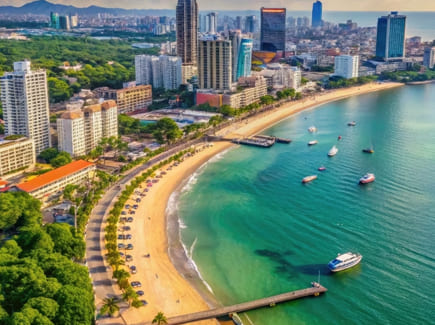
Thailand suits first-timers, groups of friends, honeymooners on a budget, and families — with the one caveat that Pattaya's walking street area is not family territory after dark, and any operator who builds a family itinerary around central Pattaya nightlife districts has not thought about you. We put families in north Pattaya or Jomtien, or skip Pattaya entirely for Krabi.
Skip Thailand — or at least this itinerary — if you have already done Bangkok–Pattaya twice; go to Vietnam instead, which is where Thailand's value-for-money crown is migrating, or step up to Phuket–Krabi (we have a separate page for that, because it is really a different holiday).
Best time to visit Thailand from Delhi — month by month
| Month | Weather reality | What it means for your trip | Price pressure |
|---|---|---|---|
| January | Cool, dry season, 22–32°C | Peak of peaks. Everything works. | Very high |
| February | Dry, warming slightly | Excellent everywhere. Best sea conditions for islands. | High |
| March | Hot, dry | Beaches fine; Bangkok sightseeing gets sweaty by noon. | Medium-high |
| April | Hottest month; Songkran mid-month | Songkran (Thai new year water festival) is a spectacle — and a surcharge. | Spikes at Songkran |
| May | Hot, first rains | Shoulder value begins. Short sharp showers, not washouts. | Falling |
| June | Rainy season | Usable, cheap. Andaman sea gets rough — island boats cancel. | Low |
| July | Rainy | Same. Gulf side (Koh Samui) is drier than Phuket side. | Low |
| August | Rainy | Cheapest good hotels of the year. | Lowest |
| September | Wettest month | The one month we honestly talk people out of. | Lowest |
| October | Rains easing | Underrated. Green landscapes, thinning rain, pre-season rates. | Rising |
| November | Dry season begins | Season proper. Loy Krathong lantern festival, usually this month. | High |
| December | Cool, dry | Excellent; Christmas–New Year week is the year's most expensive. | Extreme |
The genuinely useful recommendation: November or February. If budget leads, late October gets you 80% of the season at 60% of the price. Avoid September unless the price is irresistible and your plan is city-and-spa rather than islands.
How many days do you actually need?
Five nights is the honest minimum for Bangkok plus one other place. Four nights works only for a single-base trip (Bangkok alone, or Pattaya alone). Seven nights lets you add an island properly. We regularly talk enquirers down from three-city-in-five-nights plans — Thailand's internal hops are cheap, but every move eats half a day, and a holiday assembled from half-days is a checklist, not a holiday.
Three Thailand itineraries that actually run
Itinerary A — 5N/6D Bangkok (2N) + Pattaya (3N): the classic first trip
Day 1 — Arrive Bangkok, transfer to Pattaya. Land at Suvarnabhumi (BKK); the 2-hour road transfer to Pattaya straight from the airport beats checking into Bangkok twice. Evening free at Jomtien beach. Overnight Pattaya. Day 2 — Coral Island (Koh Larn) day trip. Speedboat morning, beach and optional watersports, back by mid-afternoon. Evening: Alcazar or Tiffany's cabaret show — book the earlier show with children. Overnight Pattaya. Day 3 — Pattaya at your pace. Sanctuary of Truth in the morning light, Nong Nooch gardens for families, or simply the pool. Overnight Pattaya. Day 4 — Transfer to Bangkok, evening river. Check in, then a Chao Phraya dinner cruise — touristy, and still worth it once. Overnight Bangkok. Day 5 — Bangkok temples and markets. Grand Palace and Wat Pho in the morning (dress code: covered shoulders and knees — carry a stole), afternoon at Chatuchak (weekends) or MBK/Platinum for shopping. Overnight Bangkok. Day 6 — Departure. Morning free; allow 3 hours at BKK.
Itinerary B — 6N/7D Bangkok (2N) + Phuket (4N): the beach-led version
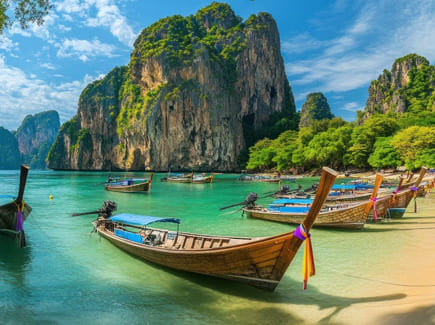
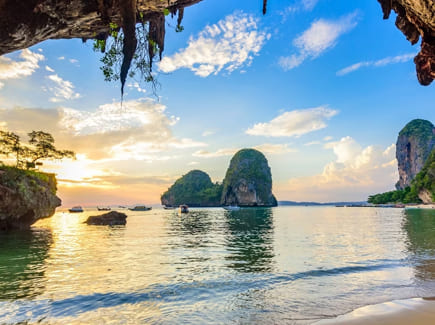
Day 1 — Delhi to Bangkok, evening street-food walk in Sukhumvit. Day 2 — Grand Palace, Wat Arun by boat, rooftop evening. Day 3 — Fly to Phuket (1h20 internal hop), sunset at Karon or Kata beach. Day 4 — Phi Phi Islands day cruise. Full day by speedboat or the gentler big boat — choose the big boat if anyone in the group gets seasick. Day 5 — James Bond Island / Phang Nga Bay canoeing, or a rest day. Day 6 — Old Phuket Town morning (Sino-Portuguese shophouses, genuinely good cafés), Big Buddha viewpoint, evening at Bangla Road for couples/friends or a beach dinner for families. Day 7 — Fly Phuket–Delhi (usually via Bangkok).
Itinerary C — 5N/6D Bangkok (3N) + Ayutthaya + Khao Yai flavour: for repeat visitors
Day 1 — Arrive Bangkok. Day 2 — Ayutthaya UNESCO ruins day trip — the Thailand almost no Indian package shows, 90 minutes from the city. Day 3 — Bangkok's newer face: ICONSIAM, Chinatown food street in the evening. Day 4 — Floating market (Damnoen Saduak or the more local Amphawa) + Maeklong railway market. Day 5 — Free day: cooking class, spa, or Chatuchak. Day 6 — Depart.
What a Thailand trip really costs from Delhi
*₹35,000–₹70,000 per person (indicative · 5N/6D · ex-Delhi · twin sharing · excludes GST & TCS)** *Indicative market range as of Aug 2026. Contact us on +91 97299 91755 for a current quote.
The bottom of that range is a 3-star Bangkok–Pattaya trip on a budget carrier bought well in advance in the rainy season; the top is a 4-star December trip with the Phi Phi cruise and better transfers. Land-only packages advertised at "₹11,000–₹28,000" are real but exclude the single biggest cost — the flight — which is why comparing package prices without reading inclusions is how people get disappointed.
Sitting outside every package price, whoever you book with:
- Visa: currently zero. Thailand charges Indians no visa fee under the exemption. Budget instead a few hundred rupees if you want travel insurance (you should).
- TCS — collected at booking on overseas packages, credited back against your income tax when you file your ITR; it is a prepayment, not a cost that disappears. Exact current rate: confirm with us at quote time.
- GST on the package invoice.
- Personal spends: street food, shopping, watersports, tips. Watersports at Coral Island and shows in Pattaya are where budgets quietly grow — a parasail here and a jet-ski there is easily ₹5,000–8,000 per person.
Flights from Delhi
Delhi to Bangkok is a nonstop of roughly 4 to 4.5 hours, flown by Air India, IndiGo and Thai Airways among others, into either Suvarnabhumi (BKK — most full-service flights) or Don Mueang (DMK — some low-cost flights). Thailand is 1.5 hours ahead of IST, so jet lag is a non-issue. For Phuket or Krabi trips, it is normally cheaper to fly into Bangkok and take the internal hop than to fly direct to the island airports, but we price both at quote time.
Currency and daily spend
Thailand uses the Thai Baht (THB); in August 2026 one baht is roughly ₹2.5–2.7 — check the day's rate before you exchange. Practical daily budget on the ground, per person, outside what the package covers: a street-food meal runs 60–100 baht, a decent sit-down Indian meal 300–500 baht, a taxi or Grab hop 100–250 baht. ₹2,000–3,500 per person per day covers food and local movement comfortably. Exchange a small amount in Delhi, use ATMs or licensed exchange counters (SuperRich in Bangkok has long given better rates than airport counters) for the rest, and note Thai ATMs charge a fixed fee per withdrawal — fewer, larger withdrawals win.
Honeymoon, family, friends — how the same country changes shape
Honeymooners: skip Pattaya. Bangkok 2N + Phuket or Krabi 3–4N, one private dinner, one island day cruise, a pool-access or sea-view room upgrade — the upgrade costs less in Thailand than anywhere comparable. Families: Bangkok's Safari World and SEA LIFE, Coral Island's calm morning waters, Nong Nooch gardens; stay Jomtien-side in Pattaya; earlier show timings; request mild-spice at every included meal — Thai kitchens genuinely deliver this when asked. Friends' groups: this is Thailand's home ground. Bangkok nightlife, Pattaya, full-day island cruises; budget-stretch trick — travel Sunday to Friday, not Saturday to Saturday, and the same trip drops noticeably.
Food — the vegetarian and Jain reality
Better than you have heard, with honest caveats. Thai cooking leans on fish sauce and oyster sauce, so "vegetable" dishes in ordinary restaurants are often not strictly vegetarian. The workable approaches: the word "jay" (เจ) signals Thai Buddhist vegan food, and jay-flagged stalls and restaurants exist in every city; tourist-belt restaurants understand "no fish sauce, no egg" when said clearly; and Indian restaurants are dense on the ground in Bangkok (Sukhumvit, Pahurat — the city's Little India), Pattaya and Phuket, including pure-veg options. Jain travellers: eating from Thai kitchens is genuinely difficult (garlic, onion, root vegetables and fish sauce are foundational); the reliable path is Indian Jain-aware restaurants plus hotel breakfasts, and we pre-arrange Jain meals with hotels on request — tell us at enquiry, not at the airport. Fruit is a Thai glory: mangosteen, rambutan and mango sticky rice (ask for it without the coconut-cream drizzle if vegan) rescue any dietary gap.
What NOT to do in Thailand
- Do not buy the "Thailand visa" that agents and some websites still sell. Entry is visa-free. Pay only for real services — TDAC filing help, insurance, transfers.
- Do not rent a scooter without a valid international driving permit and helmet — police checkpoints in Phuket and Pattaya fine tourists daily, and your travel insurance is void without a licence.
- Do not touch the tiger-selfie and elephant-riding attractions. Beyond the ethics, a genuine sanctuary visit is a better experience and photographs better.
- Do not disrespect temple dress codes or images of the Thai royal family — the latter is a criminal offence in Thailand, not a cultural nicety.
- Do not accept "gem deals", tuk-tuk detours to "government shops", or the famous "Grand Palace is closed today" line — it is open; the man outside is taking you shopping.
Common mistakes Delhi travellers make
Booking a September beach trip because the price looked unbeatable, then meeting the monsoon. Comparing a land-only ₹15,000 package with a with-flights ₹45,000 one as if they were the same product. Leaving the TDAC to the airport queue. Carrying only ₹500-per-day cash instincts into a country where the fun costs (watersports, shows, cruises) are paid on the spot. And under-budgeting the last day in Bangkok — the shopping is genuinely good, and everyone spends more than they planned.
Operator's note (FILL BEFORE PUBLISH): [YashTrip observation hook — e.g. the actual % of our Thailand enquiries that ask "is visa-free still true?", or a real TDAC-at-the-airport rescue story from a group departure.]
Frequently asked questions
Is Thailand visa-free for Indians right now?
Yes. As of our check on 27 August 2026, Indian passport holders enter Thailand visa-free for up to 60 days — no visa, no fee. A cabinet-approved change will shorten the stay to 30 days once published in the Royal Gazette, but visa-free entry itself continues. Ignore pages claiming Thailand "ended" visa-free entry for Indians; that is not what the official Thai position says.
Will the Thailand visa rule change affect my holiday?
Almost certainly not. The approved change reduces the visa-free stay from 60 days to 30 — and hardly any holiday runs longer than two weeks. There is no fee either way. We re-check the official Thai sources at the time of every booking and tell you the rule that applies to your dates.
What is the TDAC and do I really need it?
Yes — it is mandatory. The Thailand Digital Arrival Card is a free online form on the Thai Immigration Bureau site (tdac.immigration.go.th), filed within 72 hours before arrival, one per person per entry, children included. It replaced the paper arrival card in May 2025. We file it for all our passengers as part of the package.
How much does a Thailand trip cost from Delhi?
Indicatively ₹35,000–₹70,000 per person for 5 nights, twin sharing, with flights, as of August 2026 — excluding GST and TCS. Rainy-season trips booked early sit at the bottom of that range; December with islands sits at the top. Contact us on +91 97299 91755 for a current quote for your dates.
How long is the flight from Delhi to Bangkok?
About 4 to 4.5 hours nonstop. Air India, IndiGo and Thai Airways fly the route, into Suvarnabhumi or Don Mueang airports. Thailand runs 1.5 hours ahead of India, so there is no real jet lag in either direction.
Which is better for a first trip — Bangkok-Pattaya or Bangkok-Phuket?
Bangkok–Pattaya is cheaper and shorter (no internal flight); Bangkok–Phuket is prettier and better for couples and beach-led trips. Families and first-time groups usually pick Pattaya for cost; honeymooners should pay the difference for Phuket or Krabi. If the islands are the whole point, see our separate Phuket–Krabi page.
Is Thailand good for vegetarians?
Workable, with knowledge. Ordinary Thai kitchens use fish sauce in "vegetable" dishes, so say "no fish sauce, no oyster sauce, no egg" clearly, look for "jay" (Thai vegan) signage, or use the many Indian restaurants in Bangkok, Pattaya and Phuket. Jain travellers should tell us at enquiry so we pre-arrange meals — walk-in Jain eating is genuinely hard.
Is Pattaya okay for families?
Parts of it. Jomtien and north Pattaya, Coral Island mornings, Nong Nooch gardens and the cabaret's early show are all family-appropriate. Central walking-street nightlife after dark is not. A well-built family itinerary keeps you in the right zones — this is exactly the kind of thing to ask an operator before booking, not after landing.
How much money should I carry to Thailand?
Beyond the package, budget ₹2,000–3,500 per person per day for food, local transport and small buys, plus a separate kitty for watersports, shows and shopping. Thai immigration can also spot-check tourists for proof of funds, so keep access to roughly 10,000 baht per person. Exchange small amounts at good-rate counters, not at the airport.
What is the best month for Thailand?
November to February — dry, relatively cool, and the sea is at its best. February is our pick for islands. October is the value sweet spot as rains fade. September is the one month we honestly discourage for beach trips; if you must travel in the monsoon, keep the plan city-and-spa shaped.